Immunity on a Timer: Why Vaccinated Americans Are Increasingly Vulnerable to Diseases Once Considered Defeated
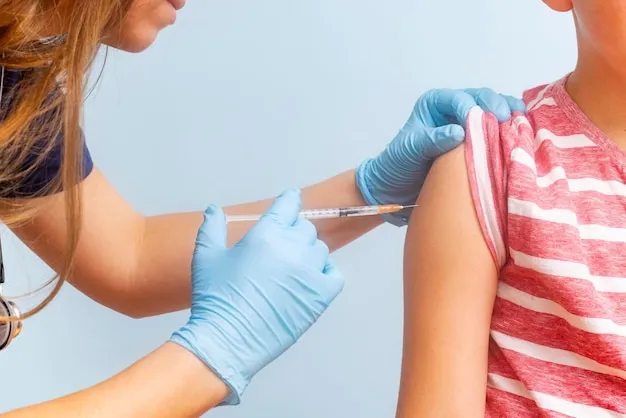
Photo: vaccine syringe childhood immunization public health clinic, via img.freepik.com
For much of the late twentieth century, the arc of American public health bent steadily toward the elimination of childhood infectious diseases. Vaccination campaigns drove measles cases to historic lows, pertussis seemed manageable, and varicella — chickenpox — became a relic of an earlier era after the introduction of the Varivax vaccine in 1995. Parents who had themselves suffered through these illnesses expected their children to be spared entirely.
That expectation has grown increasingly complicated. Outbreaks of measles, pertussis, and varicella have reappeared not only in unvaccinated communities but in populations with documented, sometimes high, vaccination rates. Understanding why requires moving beyond the familiar debate over vaccine hesitancy and into more nuanced epidemiological territory — one that public health messaging has been slow to address honestly.
When 'Fully Vaccinated' Is Not a Permanent Status
The first piece of the puzzle is immunological: vaccine-induced immunity is not always lifelong. For measles, two doses of the MMR vaccine confer strong protection that appears durable for most individuals, but serological studies have found that a measurable proportion of vaccinated adults show declining antibody titers over decades. For pertussis, the evidence is considerably more troubling. The acellular pertussis vaccine, which replaced the older whole-cell formulation in the United States during the 1990s, generates a faster-fading immune response. Research published in the journal Pediatrics and subsequent CDC analyses have documented that protection against pertussis can wane substantially within four to six years of the last dose — a timeline that leaves adolescents and young adults particularly exposed.
Varicella occupies its own complicated niche. A single-dose schedule, used from 1995 until 2006, produced lower-than-expected immunity in a portion of recipients. When the two-dose schedule became standard, coverage improved, but an entire cohort vaccinated under the earlier protocol had already moved into adulthood with potentially incomplete protection. Breakthrough cases — infections occurring in previously vaccinated individuals — became a recognized phenomenon that the original public messaging around the vaccine had not prepared families to anticipate.
The Herd Immunity Threshold and Its Hidden Vulnerabilities
Herd immunity is often presented as a binary achievement: either a community reaches the required coverage threshold and disease transmission collapses, or it does not. In practice, the concept is considerably more dynamic. Herd immunity thresholds are calculated based on assumptions about the uniformity of immune protection across a population. When a significant proportion of vaccinated individuals carry waning or incomplete immunity — even if they were technically vaccinated — the effective protection level within a community can fall below what aggregate vaccination statistics suggest.
This distinction has real consequences. A school district reporting ninety-two percent MMR vaccination coverage may appear to exceed the threshold required to prevent measles transmission. But if a subset of those vaccinated individuals received their doses fifteen or more years ago and have experienced meaningful antibody decline, the functional immunity landscape looks different from what the numbers alone convey.
Geographic clustering compounds the problem. Vaccine hesitancy is not randomly distributed across the United States. Communities with concentrated populations of vaccine-hesitant families — whether motivated by religious conviction, philosophical objection, or distrust of medical institutions — create pockets of susceptibility that can sustain transmission chains even when statewide coverage appears adequate. The 2019 measles outbreak centered in Orthodox Jewish communities in New York and New Jersey illustrated precisely this dynamic, with over nine hundred confirmed cases in a state that maintains strong overall vaccination rates.
A Failure of Nuanced Communication
Public health authorities face a genuine dilemma in how they communicate about vaccines and long-term protection. Acknowledging that immunity can wane risks being weaponized by vaccine-skeptical communities as evidence that vaccination is ineffective. The temptation to present vaccines in simplified, maximally reassuring terms is understandable, but it has costs.
When parents who vaccinated their children on schedule encounter breakthrough infections, the experience can generate confusion and eroded trust — not because the vaccine failed in any absolute sense, but because the nuances of waning immunity and booster timing were never adequately explained. The CDC's Advisory Committee on Immunization Practices (ACIP) issues detailed recommendations on booster schedules, but these recommendations rarely reach the public in accessible form. Pertussis boosters (Tdap) are recommended for adolescents and adults, yet adult compliance rates remain well below targets. The gap between official guidance and public awareness is not trivial.
Some researchers and clinicians have begun advocating for a more transparent public health communication strategy — one that frames vaccination not as a one-time transaction but as an ongoing relationship between an individual's immune system and the pathogens it faces. This framing does not undermine confidence in vaccines; properly presented, it reinforces their importance while setting realistic expectations about maintenance.
What Resurgence Actually Tells Us
It would be inaccurate to characterize the resurgence of these diseases as evidence that vaccines have failed. The data consistently show that vaccinated individuals who do contract measles, pertussis, or varicella experience milder illness and lower complication rates than unvaccinated individuals. Vaccination remains among the most effective public health interventions in human history.
But resurgence does reveal something important: the infrastructure of childhood disease prevention requires active maintenance, not passive assumption. Booster schedules must be followed. Surveillance systems must be sensitive enough to detect waning immunity trends at the population level before outbreaks occur. And public health messaging must evolve to treat the American public as capable of understanding complexity — because the alternative, a simplified narrative that breaks down at first contact with clinical reality, may ultimately do more damage to vaccine confidence than honest, evidence-based communication ever could.
The childhood diseases we believed we had conquered are not staging a comeback because science failed. They are returning because the systems built around that science — policy, communication, and follow-through — have not kept pace with what the evidence now demands.